|
Nuria Framework - Network
Network module of the NuriaProject Framework
|
|
Nuria Framework - Network
Network module of the NuriaProject Framework
|
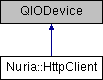
The HttpClient class represents a connection to a client. More...
#include <httpclient.hpp>
Public Types | |
| enum | HttpVersion { HttpUnknown, Http1_0, Http1_1 } |
| enum | HttpVerb { InvalidVerb = 0, GET = 1, POST = 2, HEAD = 4, PUT = 8, DELETE = 16, AllVerbs = GET | POST | HEAD | PUT | DELETE } |
| enum | HttpHeader { HeaderCacheControl = 0, HeaderContentLength, HeaderContentType, HeaderConnection, HeaderDate, HeaderHost = 1000, HeaderUserAgent, HeaderAccept, HeaderAcceptCharset, HeaderAcceptEncoding, HeaderAcceptLanguage, HeaderAuthorization, HeaderCookie, HeaderRange, HeaderReferer, HeaderDoNotTrack, HeaderExpect, HeaderContentEncoding = 2000, HeaderContentLanguage, HeaderContentDisposition, HeaderContentRange, HeaderLastModified, HeaderRefresh, HeaderSetCookie, HeaderTransferEncoding, HeaderLocation } |
| typedef QMultiMap< QByteArray, QByteArray > | HeaderMap |
| typedef QMap< QByteArray, QNetworkCookie > | Cookies |
Public Slots | |
| bool | killConnection (int error, const QString &cause=QString()) |
| bool | sendResponseHeader () |
| void | close () override |
| void | forceClose () |
Signals | |
| void | disconnected () |
| void | headerReady () |
| void | postBodyComplete () |
Public Member Functions | |
| HttpClient (HttpTransport *transport, HttpServer *server) | |
| virtual | ~HttpClient () |
| HttpTransport * | transport () const |
| bool | isHeaderReady () const |
| bool | responseHeaderSent () const |
| HttpVerb | verb () const |
| QUrl | path () const |
| bool | hasRequestHeader (const QByteArray &key) const |
| bool | hasRequestHeader (HttpHeader header) const |
| QByteArray | requestHeader (const QByteArray &key) const |
| QByteArray | requestHeader (HttpHeader header) const |
| QList< QByteArray > | requestHeaders (const QByteArray &key) const |
| QList< QByteArray > | requestHeaders (HttpHeader header) const |
| const HeaderMap & | requestHeaders () const |
| bool | hasResponseHeader (const QByteArray &key) const |
| bool | hasResponseHeader (HttpHeader header) const |
| const HeaderMap & | responseHeaders () const |
| QList< QByteArray > | responseHeaders (const QByteArray &key) const |
| QList< QByteArray > | responseHeaders (HttpHeader header) const |
| bool | setResponseHeader (const QByteArray &key, const QByteArray &value, bool append=false) |
| bool | setResponseHeader (HttpHeader header, const QByteArray &value, bool append=false) |
| bool | setResponseHeaders (const HeaderMap &headers) |
| bool | pipeToClient (QIODevice *device, qint64 maxlen=-1) |
| bool | pipeFromPostBody (QIODevice *device, bool takeOwnership=false) |
| qint64 | rangeStart () const |
| qint64 | rangeEnd () const |
| qint64 | contentLength () const |
| bool | setRangeStart (qint64 pos) |
| bool | setRangeEnd (qint64 pos) |
| bool | setContentLength (qint64 length) |
| virtual bool | isSequential () const |
| qint64 | postBodyLength () const |
| qint64 | postBodyTransferred () |
| QHostAddress | localAddress () const |
| quint16 | localPort () const |
| QHostAddress | peerAddress () const |
| quint16 | peerPort () const |
| int | responseCode () const |
| void | setResponseCode (int code) |
| bool | isConnectionSecure () const |
| HttpServer * | httpServer () const |
| Cookies | cookies () |
| QNetworkCookie | cookie (const QByteArray &name) |
| bool | hasCookie (const QByteArray &name) |
| void | setCookie (const QByteArray &name, const QByteArray &value, const QDateTime &expires, bool secure=false) |
| void | setCookie (const QByteArray &name, const QByteArray &value, qint64 maxAge=0, bool secure=false) |
| void | setCookie (const QNetworkCookie &cookie) |
| void | removeCookie (const QByteArray &name) |
| bool | keepConnectionOpen () const |
| void | setKeepConnectionOpen (bool keepOpen) |
| SlotInfo | slotInfo () const |
| void | setSlotInfo (const SlotInfo &info) |
| bool | hasReadablePostBody () const |
| HttpPostBodyReader * | postBodyReader () |
| bool | atEnd () const override |
| qint64 | pos () const override |
| qint64 | size () const override |
| bool | seek (qint64 pos) override |
| bool | reset () override |
Static Public Member Functions | |
| static QByteArray | httpStatusCodeName (int code) |
| static QByteArray | httpHeaderName (HttpHeader header) |
Protected Member Functions | |
| virtual qint64 | readData (char *data, qint64 maxlen) |
| virtual qint64 | writeData (const char *data, qint64 len) |
| bool | resolveUrl (const QUrl &url) |
| bool | bufferPostBody () |
Friends | |
| class | HttpServer |
| class | HttpNode |
The HttpClient class represents a connection to a client.
This class is used whenever interaction with the HTTP client is necessary. It provides a simple way to transfer data from and to the client.
Connection: keep-alive. This means that a client has to open a connection for each request. This problem will be addressed in the future.This is possible for both directions: You can either pipe a buffer to the client, or pipe the clients post body into a QIODevice.
An example would be to use this to process a file while the user is still uploading it.
delete or deleteLater a HttpClient instance! Use close instead!| typedef QMap< QByteArray, QNetworkCookie > Nuria::HttpClient::Cookies |
List of cookies.
| typedef QMultiMap< QByteArray, QByteArray > Nuria::HttpClient::HeaderMap |
Map used to store HTTP headers in a name -> value fashion.
The HttpVerb enum contains a list of possible HTTP request types.
|
explicit |
Constructs a new HttpClient instance which uses transport as communication back-end. Ownership of transport is transferred to the HttpClient instance.
|
virtual |
Destructor.
|
override |
Returns true if the POST body has been completely read by the user. Also returns true if the request has no POST body at all. Returns false otherwise.
|
protected |
Takes care of buffering the POST body.
|
overrideslot |
If no data has been sent yet, but a request header has been received, a appropriate response header will be sent.
| qint64 Nuria::HttpClient::contentLength | ( | ) | const |
Returns the Content-Length. Returns -1 if the content length is unknown.
| QNetworkCookie Nuria::HttpClient::cookie | ( | const QByteArray & | name | ) |
| Cookies Nuria::HttpClient::cookies | ( | ) |
|
signal |
Gets emitted when the user just closed the connection.
|
slot |
Closes the socket without caring about the write buffer.
| bool Nuria::HttpClient::hasCookie | ( | const QByteArray & | name | ) |
| bool Nuria::HttpClient::hasReadablePostBody | ( | ) | const |
Returns true only if this request has a POST body and it's readable by one of the readers known to HttpClient, e.g. for HTTP multi-part.
| bool Nuria::HttpClient::hasRequestHeader | ( | const QByteArray & | key | ) | const |
Returns if the client has sent a value for key in the request header.
| bool Nuria::HttpClient::hasRequestHeader | ( | HttpHeader | header | ) | const |
This is an overloaded member function, provided for convenience. It differs from the above function only in what argument(s) it accepts.
| bool Nuria::HttpClient::hasResponseHeader | ( | const QByteArray & | key | ) | const |
Returns true when key has a value in the response header
| bool Nuria::HttpClient::hasResponseHeader | ( | HttpHeader | header | ) | const |
This is an overloaded member function, provided for convenience. It differs from the above function only in what argument(s) it accepts.
|
signal |
Gets emitted when the client has sent the header.
|
static |
Returns the name of a HTTP standard header.
| HttpServer* Nuria::HttpClient::httpServer | ( | ) | const |
Returns the HTTP server this client belongs to.
|
static |
Returns the HTTP name for a statuscode. If none is known for code, an empty string is returned.
| bool Nuria::HttpClient::isConnectionSecure | ( | ) | const |
Returns true if the connection is secured.
| bool Nuria::HttpClient::isHeaderReady | ( | ) | const |
Returns true if the client has sent the complete header.
|
virtual |
Returns false, meaning this is a random-access device.
true is returned. | bool Nuria::HttpClient::keepConnectionOpen | ( | ) | const |
Returns if the connection should be kept open after the slot has been called.
|
slot |
Kills the connection to the client immediatly with error as HTTP error code. If cause is not empty, it will be sent to the client. Else a appropriate cause is chosen automatically based on error.
This is only possible until the response header has been sent. If the response header has already been sent, the connection to the client will simply be destroyed.
| QHostAddress Nuria::HttpClient::localAddress | ( | ) | const |
See QAbstractSocket::localAddress.
| quint16 Nuria::HttpClient::localPort | ( | ) | const |
See QAbstractSocket::localPort.
| QUrl Nuria::HttpClient::path | ( | ) | const |
Returns the complete requested path.
| QHostAddress Nuria::HttpClient::peerAddress | ( | ) | const |
See QAbstractSocket::peerAddress.
| quint16 Nuria::HttpClient::peerPort | ( | ) | const |
See QAbstractSocket::peerPort.
| bool Nuria::HttpClient::pipeFromPostBody | ( | QIODevice * | device, |
| bool | takeOwnership = false |
||
| ) |
Uses device from now on as buffer device. You can use this for example when you write an application which takes the POST body data, processes it somehow and then pipeToClient() the data back. The data in the current buffer is written to device.
Upon calling, the openMode of the HttpClient will be changed to QIODevice::WriteOnly.
nullptr. | bool Nuria::HttpClient::pipeToClient | ( | QIODevice * | device, |
| qint64 | maxlen = -1 |
||
| ) |
Takes device and pipes its contents into the client socket. After this call, any other write call will fail. The ownership of device will be transferred to this instance and thus will be destroyed when the client quits or device has no more data to read.
|
signal |
Gets emitted when the transfer of the POST body has been completed.
| qint64 Nuria::HttpClient::postBodyLength | ( | ) | const |
Convenience function, returns the length of the POST body using the Content-Length header.
| HttpPostBodyReader* Nuria::HttpClient::postBodyReader | ( | ) |
If hasReadablePostBody() returns true, returns a suitable POST body reader instance. Else returns nullptr. The reader instance is owned by the HttpClient. Consecutive calls of this method will always return the same result. The first call will create the reader.
| qint64 Nuria::HttpClient::postBodyTransferred | ( | ) |
Returns how many bytes have been transferred of the POST body.
| qint64 Nuria::HttpClient::rangeEnd | ( | ) | const |
Returns the end position of a 'range' request. If the client sent a valid 'Range' header, this method will return the end of the requested range. Else -1 is returned.
| qint64 Nuria::HttpClient::rangeStart | ( | ) | const |
Returns the start position of a 'range' request. If the client sent a valid 'Range' header, this method will return the start of the requested range. Else -1 is returned.
|
protectedvirtual |
Implementation of QIODevice::readData.
| void Nuria::HttpClient::removeCookie | ( | const QByteArray & | name | ) |
Removes a cookie. If the cookie is known by the client it will also removed client-side. If the cookie is only known on server-side it will only be removed from there. If no cookie name is known nothing happens.
| QByteArray Nuria::HttpClient::requestHeader | ( | const QByteArray & | key | ) | const |
Returns a value of a header from the request. If the client sent multiple values for the header, this method returns the last one. Returns an empty QByteArray if there was no header named key.
| QByteArray Nuria::HttpClient::requestHeader | ( | HttpHeader | header | ) | const |
This is an overloaded member function, provided for convenience. It differs from the above function only in what argument(s) it accepts.
| QList< QByteArray > Nuria::HttpClient::requestHeaders | ( | const QByteArray & | key | ) | const |
Returns the values of a header from the request. This method is useful for headers which may appear multiple times. Returns an empty QByteArray if there was no header named key.
| QList< QByteArray > Nuria::HttpClient::requestHeaders | ( | HttpHeader | header | ) | const |
This is an overloaded member function, provided for convenience. It differs from the above function only in what argument(s) it accepts.
| const HeaderMap& Nuria::HttpClient::requestHeaders | ( | ) | const |
Returns a map of received request headers.
|
protected |
Resolves the URL from the client. That means that the code tries to find the associated slot of url and calls it if possible. Returns true on success.
| int Nuria::HttpClient::responseCode | ( | ) | const |
Returns the HTTP response code. Default is 200 OK
| const HeaderMap& Nuria::HttpClient::responseHeaders | ( | ) | const |
Returns the current response headers.
| QList< QByteArray > Nuria::HttpClient::responseHeaders | ( | const QByteArray & | key | ) | const |
Returns the response headers with key key.
| QList< QByteArray > Nuria::HttpClient::responseHeaders | ( | HttpHeader | header | ) | const |
This is an overloaded member function, provided for convenience. It differs from the above function only in what argument(s) it accepts.
| bool Nuria::HttpClient::responseHeaderSent | ( | ) | const |
Returns true if the response header has been sent. The response header will be sent on the first write call to the instance or if the sendResponseHeader method has been called explicitly.
|
slot |
Explicitly sends a response header to the client. Fails if the client hasn't send a request so far (isHeaderReady() returns false) or if the response header has already been sent (In this case responseHeaderSent() returns true).
| bool Nuria::HttpClient::setContentLength | ( | qint64 | length | ) |
Sets the Content-Length. Used in conjunction with range responses.
| void Nuria::HttpClient::setCookie | ( | const QByteArray & | name, |
| const QByteArray & | value, | ||
| const QDateTime & | expires, | ||
| bool | secure = false |
||
| ) |
Sets a cookie on the client using a HTTP header. If there is already a cookie with name, it will be overridden. If secure is true the client is avised to only send the cookie to the server if a secure connection is used.
| void Nuria::HttpClient::setCookie | ( | const QByteArray & | name, |
| const QByteArray & | value, | ||
| qint64 | maxAge = 0, |
||
| bool | secure = false |
||
| ) |
This is an overloaded member function, provided for convenience. It differs from the above function only in what argument(s) it accepts. Sets a cookie on the client using a HTTP header. If there is already a cookie with name, it will be overridden. maxAge defines the maximum age of the cookie in seconds. If it's 0, the cookie will removed by the client at the end of the session. If secure is true the client is avised to only send the cookie to the server if a secure connection is used.
0 (the default), the cookie will be a session cookie. | void Nuria::HttpClient::setCookie | ( | const QNetworkCookie & | cookie | ) |
This is an overloaded member function, provided for convenience. It differs from the above function only in what argument(s) it accepts. Sets a cookie on the client using a HTTP header. Use this overload if the other overloads aren't specific enough.
| void Nuria::HttpClient::setKeepConnectionOpen | ( | bool | keepOpen | ) |
Sets whether the HTTP connection should be kept open after a slot has been called. By default, this is not the case.
| bool Nuria::HttpClient::setRangeEnd | ( | qint64 | pos | ) |
Sets the end position of a range response.
| bool Nuria::HttpClient::setRangeStart | ( | qint64 | pos | ) |
Sets the start position of a range response.
| void Nuria::HttpClient::setResponseCode | ( | int | code | ) |
Sets the HTTP response code.
| bool Nuria::HttpClient::setResponseHeader | ( | const QByteArray & | key, |
| const QByteArray & | value, | ||
| bool | append = false |
||
| ) |
Sets a response header. Returns true if the response header has not yet been sent. If it was already sent to the client, the function will fail as HTTP doesn't allow to send additional headers after the HTTP header. In this case the response header map won't be modified. If append is true and there is already a value for key, then the new value will be appended to the list.
| bool Nuria::HttpClient::setResponseHeader | ( | HttpHeader | header, |
| const QByteArray & | value, | ||
| bool | append = false |
||
| ) |
This is an overloaded member function, provided for convenience. It differs from the above function only in what argument(s) it accepts.
| bool Nuria::HttpClient::setResponseHeaders | ( | const HeaderMap & | headers | ) |
Sets the response header map.
| void Nuria::HttpClient::setSlotInfo | ( | const SlotInfo & | info | ) |
| SlotInfo Nuria::HttpClient::slotInfo | ( | ) | const |
Returns the associated slot info of the client.
| HttpTransport* Nuria::HttpClient::transport | ( | ) | const |
Returns the internal HttpTransport instance.
| HttpVerb Nuria::HttpClient::verb | ( | ) | const |
Returns the HTTP verb used by the client.
|
protectedvirtual |
Implementation of QIODevice::writeData.
 1.8.7
1.8.7

